
Flooring for Rental Properties in Melbourne: A Landlord’s Guide
Hybrid and laminate suit most rentals: tough, quick to lay and easy to repair one board at a time. Engineered oak pays off in higher-end, long-term rentals.
Read the guide
Quick answer
For most kitchens, hybrid is the safest choice because it is highly water resistant and tough on dents. Engineered oak suits open-plan homes that want real timber and can be refinished later, as long as spills are wiped promptly. Laminate looks good but is the least forgiving of water pooling at the joins.
The best flooring for kitchens in most Melbourne homes is either a good hybrid or engineered oak. Hybrid copes best with spills and dishwasher leaks and is the low-worry choice for a busy family kitchen. Engineered oak gives you real timber that can run through an open-plan living area and be refinished later, but it needs spills wiped up promptly. Laminate looks good and costs less to lay, but it is the least forgiving of standing water at the joins.
A kitchen is hard on a floor in a few specific ways. Water lands on it every day: drips from the sink, a pot that boils over, a dog bowl that gets knocked. Then there are the less frequent but more serious events, like a dishwasher hose that weeps for a week before anyone notices, or a fridge water line that lets go overnight. Add grit from the back door, dropped cans and pans, and chairs dragged in and out at the bench, and you can see why the kitchen is where floors wear first.
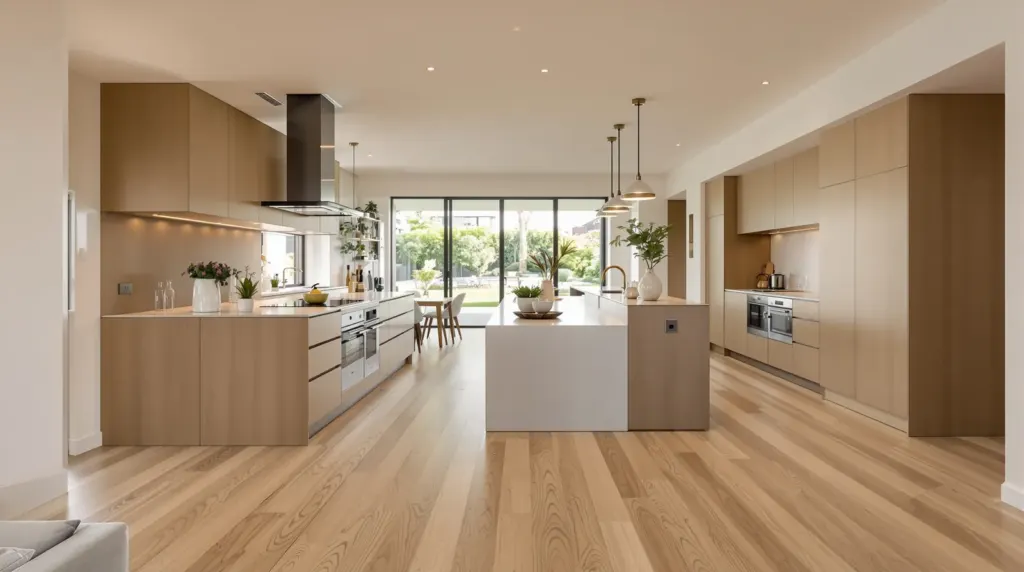
The other thing about kitchens in Melbourne homes is that they are rarely separate rooms now. Most renovations and new builds open the kitchen to the meals and living area, so the kitchen floor is usually the same floor that runs through half the house. That changes the decision. You are picking the toughest surface for one room and, at the same time, a floor you will look at from the couch every night.
Our SPC hybrid range has a rigid stone-plastic core with a printed timber look under a clear wear layer. The product data for these boards rates them highly water resistant, fine for laundries and bathrooms but not showers or anywhere with running water. In a kitchen that means a spilled glass of water or a splash in front of the sink is not a problem if you wipe it up the same day.
What hybrid will not do is sit in water for days. A slow leak under the dishwasher can still get into the joins and the subfloor. No floating floor is a substitute for fixing the leak.
Hybrid also handles scratches and dents from dropped utensils better than a timber surface, and most boards come with an attached acoustic underlay, which helps with the clatter of a busy kitchen. The trade-off is that it is not real timber and cannot be sanded back. If a board is badly damaged, it is replaced rather than refinished. Our hybrid pros and cons guide covers the rest.
A practical example: Classic Blackbutt Hybrid gives you a warm Australian hardwood look with fairly calm grain, which works well across a long open-plan room.
Plenty of people want real timber in the kitchen, and engineered oak is a sound choice if you go in with your eyes open. The top layer is real oak, factory finished, over a stable plywood-style base. It feels warmer and softer underfoot than hybrid and it looks like what it is.
Timber does not like water sitting on it. A spill wiped up within minutes is fine. A puddle left overnight, or a leak that runs for days, can stain the finish and make boards cup at the edges. If your household is the type that cleans as it goes, that is a manageable risk. If the kitchen is chaotic, think hard about it.
The advantage over hybrid and laminate is that a worn engineered floor can usually be sanded and recoated, depending on the wear layer. Ten years of chair scrapes in front of the bench can be fixed instead of living with them. Our guide to engineered oak pros and cons goes into this in more detail.
Our laminate range is 12 mm boards with an embossed-in-register surface, so the texture follows the grain and it reads as timber from standing height. It is tough on the surface and quick to lay as a floating floor.
The weak point in a kitchen is the core. Laminate has a fibreboard core, and our own care advice for it is simple: do not let water pool on the joins. A drip wiped up straight away is fine. The edge of a dishwasher that leaks, or a spot in front of the sink where water sits, is where laminate swells first. If you choose laminate for a kitchen, be strict about mats at the sink and checking the dishwasher hose. The hybrid vs laminate comparison sets the two side by side.
| Hybrid | Engineered oak | Laminate | |
|---|---|---|---|
| Everyday spills | Handles them well | Fine if wiped up promptly | Fine if wiped up straight away |
| Slow leaks | Joins and subfloor still at risk | Staining and cupping | Swelling at the joins |
| Dropped pans | Resists dents well | Can dent, like any timber | Hard surface, can chip |
| Feel and sound | Firm, quieter with underlay | Warmest underfoot | Firm, can sound hollow |
| Refinishing later | No, replace boards | Usually yes | No, replace boards |
| Through open plan | Yes | Yes, best look | Yes |
This is the part people often do not ask about until the cabinet maker is booked. Floating floors, which includes hybrid and laminate and some engineered boards, need to move slightly with the seasons. If a heavy island bench or a full run of cabinets is installed on top of a floating floor, it pins the floor down and can cause gapping or peaking elsewhere. So with a floating floor, the usual order is cabinets first, then the floor laid up to the kickboards, with an expansion gap hidden behind them.
A glued-down engineered floor is different. It does not need to move the same way, so in some jobs it can go down first and the cabinets go on top. That decision depends on the product, the subfloor and how likely you are to change the kitchen later. Our guide to floating vs glue-down floors explains the difference. Either way, tell us early who is doing the kitchen and when, so the floor and the joinery are sequenced properly.
Two more details worth sorting before the floor goes in. Leave the dishwasher and fridge spaces clear and finished so the appliances can be pulled out for service without catching the floor edge. And check the height where the kitchen floor meets tiles in the laundry or hallway, so you do not end up with a trip edge.
The quickest way to choose is to take samples home and put them on your kitchen floor next to the cabinets and benchtop, in your own light. Visit the showroom at 2/1386 Toorak Road, Camberwell, or call 1300 690 160. When you know the kitchen dates, book a free measure and quote and we will work the floor around them.
Questions
Yes, as long as spills are wiped up promptly. Engineered oak has a real timber surface, so water left sitting can stain the finish or make boards cup. The upside is that a worn kitchen floor can usually be sanded and recoated later, which hybrid and laminate cannot.
Our hybrid range is highly water resistant and rated for laundries and bathrooms, though not showers. Everyday kitchen spills are not a problem. A slow leak that runs for days can still reach the joins and the subfloor, so fix leaks quickly whatever floor you have.
With a floating floor such as hybrid or laminate, cabinets usually go in first and the floor is laid up to the kickboards, because a heavy island on top would pin the floor. A glued-down engineered floor can sometimes go under the cabinets. Tell us your kitchen dates early so we can sequence it.
It can, and it looks convincing, but it is the least tolerant of the three when water sits on the joins. Use a mat at the sink, wipe spills straight away and keep an eye on the dishwasher hose. If your kitchen gets a lot of water on the floor, hybrid is the safer pick.
Pick a floor that suits the living area as well, since one floor usually runs through both. Engineered oak gives the most natural look across a big room. Hybrid is the easier option for a busy family kitchen. Bring samples home and look at them in your own light.
Hybrid and laminate suit most rentals: tough, quick to lay and easy to repair one board at a time. Engineered oak pays off in higher-end, long-term rentals.
Read the guideOur chevron range comes in three block sizes of engineered European oak. Here is where chevron works, how to choose a size and colour, and how to plan the layout.
Read the guideWide boards look calmer in big rooms but ask more of the subfloor. How wide oak boards compare with a standard plank, with a worked room example.
Read the guide