
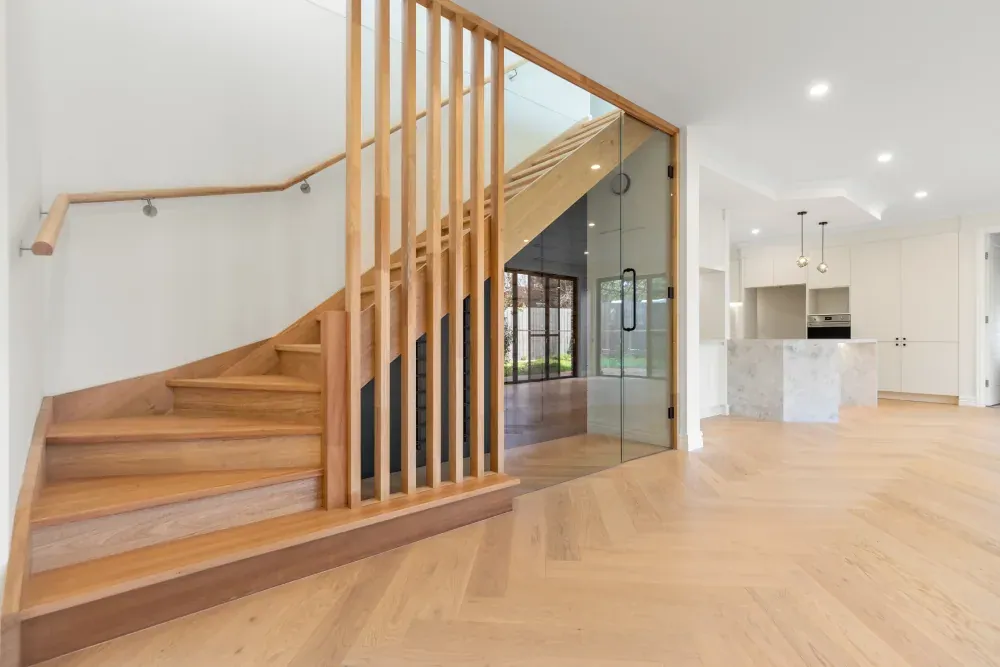
Stairs
Timber stairs to match your floor
When a new timber floor runs up to a carpeted staircase, the join is hard to miss. Matching the stairs finishes the job.
In short
Primecon Flooring can finish stairs in timber to match a new floor, including stairs that are currently carpeted. The usual approach is to clad each tread and riser over the existing stair, with a nosing on the front edge. Cost depends on the number of steps, the stair shape, the condition underneath and the nosing chosen.
Why match the stairs to the floor
In most two-storey houses and townhouses the stairs sit in the middle of the living area, and you walk past them all day. If the downstairs floor is new oak and the stairs are old carpet, the stairs can look unfinished. Doing them in the same board and colour ties the two levels together.
It is also practical. Carpet on stairs wears fastest on the front edge of each step and is hard to clean. Timber treads wipe down and don’t hold dust or pet hair the same way.
Stair options
Cladding over the existing stair
Most jobs involve cladding rather than replacing the staircase. The existing treads, and often the risers, are covered with timber pieces cut to fit each step. This is called stair cladding or capping. It is done in place, so there is no structural work, and the stairs can usually be used again soon after.
Treads only, or treads and risers
You can clad just the treads and paint the risers, which gives a lighter, two-tone look, or clad both for a solid timber look. Painted risers suit white or light-toned stairwells. Full timber suits darker or richer floors.
Nosings
The nosing is the front edge of each tread. It takes the most wear and is the part people notice. The options generally are a solid timber nosing, a nosing made to match the board, or a metal or profile trim. The choice affects how the stair looks from the bottom and how well the edge holds up.
Landings
Landings are usually laid in the same board as the floor, with nosings on the exposed edges. On a stair that turns, the landing is often where the new floor and the stair meet visually, so it is worth getting right.
Stair nosing options in more detail
From the bottom of a flight you mostly see a stack of front edges, so the nosing decides the look of the stair more than anything else. It is worth looking at samples of each type before you choose.
| Nosing type | What it looks like | Things to know |
|---|---|---|
| Square or flush | A crisp, squared front edge that reads like a solid block of timber | Suits modern interiors. Sharp corners show knocks sooner than a rounded edge. |
| Rounded or bullnose | A softened, rounded front edge | A traditional look, kinder to bare feet and a little more forgiving of knocks. |
| Matched nosing piece | A separate nosing made to go with the floorboard, fitted to the front of each tread | Keeps the colour close to the floor. It is worth asking to see how the joint between nosing and tread looks. |
| Metal or profile trim | A thin metal edge, often with a grip strip | Hard-wearing and adds grip, with a more commercial look. |
With engineered boards, look closely at the front edge. A nosing cut straight from a board can show the layers of the core, which is why purpose-made nosings are common. Where a stair has an open side, the nosing also has to return around the end of each tread, so it is worth asking how that corner will be finished.
Straight, winder and open stairs
A straight flight with walls on both sides is the simplest to clad. The treads are close to the same size and the edges finish against the wall.
Stairs that turn usually have winders, the wedge-shaped steps on the corner. Each winder is a different shape, so it is templated and cut on its own. Open-sided stairs show the end of every tread, and balusters or glass panels that sit on the treads have to be cut around, or sometimes taken off and refitted. Curved stairs take the longest of all. None of this rules a stair out. It changes the time and the cost, which is why we measure stairs in person instead of quoting from a photo.
Step heights and grip
Every step in a flight should be the same height, and people notice an odd one with their feet before their eyes. Cladding adds the same thickness to each tread, so the middle of the flight stays even. The ends are different. The bottom step gets taller and the top step gets shorter, unless the new floor at each end adds about the same thickness as the cladding. That is why the stairs and the floors are planned together.
Timber treads are harder than carpet and can be more slippery, particularly in socks. A matte or brushed finish grips better than a glossier one, and grip strips or a metal nosing add more. Some households add a runner down the middle. If young children or older relatives use the stairs, please mention it at the measure.
Matching colour and finish
The closest match comes from using the same product as the floor, or pieces finished to match it. With engineered boards, how the stair pieces are made matters, because a cut edge can show the layers inside the board. We will show you samples of the stair pieces and nosings before you commit, next to the floorboard you have chosen. If you haven’t chosen a floor yet, start with the engineered oak range or the hardwood range.
Carpet to timber stairs
Taking carpet off stairs is one of the more common stair jobs. Under the carpet you will find the underlay, gripper strips and a lot of staples or tacks. All of that comes out, and the stair is checked before any timber goes on.
What we find underneath varies. Some stairs are sound timber or concrete with a flat surface. Others have squeaky or loose treads, uneven step heights, or chipboard that has been damaged. We fix loose treads and uneven surfaces before cladding, because timber laid over a moving tread will move too. If there is a problem that needs a carpenter, we will let you know at the measure.
Cladding adds thickness to every tread. The top and bottom steps need to stay a safe, even height relative to the floors they meet, so the new floor and the stairs are planned together.
What affects the cost
Stairs are priced per job, and each step is its own small piece of work. The things that change the price are:
- the number of steps and landings
- the shape of the stair: straight flights are simpler than stairs with winders (the wedge-shaped steps on a turn), open sides or curved sections
- treads only, or treads and risers
- the nosing type and the board used
- how much repair the existing stair needs once the carpet is off
- removal and disposal of the old carpet
Stairs show as their own line on the quote, so you can see what they add. Some people do the floor first and the stairs later. That can work, but matching boards is easier when both are ordered together.
How long stairs take
Stairs are slower than flat floors because each tread is measured, cut and fitted on its own. Your quote will show how the stairs fit into the overall schedule. During the job there may be a period when the stairs are not usable. If the bedrooms are upstairs, it is worth planning around that.
Looking after timber stairs
Stairs wear in one predictable place, the front of each tread where feet land. A mat at the outside doors keeps grit down, and the stairs need vacuuming as often as the floors. Wipe with a well wrung-out mop and avoid polishes that leave a slippery film. We recommend keeping a few spare boards or nosing pieces from the original order in case one ever needs replacing.
See stair samples
You are welcome to bring photos of your staircase to the Camberwell showroom, or book a free measure & quote and we will measure the stairs with the rest of the house.
More from Primecon
Other services
Free Measure & Quote
We measure every room, check what is under the old floor and give you an itemised quote, at no cost.
Learn more02Supply & Installation
We supply the boards and install them, from your first sample through to the final trims.
Learn more03Floor Removal & Subfloor Prep
We remove carpet, tiles or old boards, then check and level the subfloor before the new floor is laid.
Learn more04Builders & Trade
Samples, specification sheets and reliable installation teams for builders, designers and renovators.
Learn more05Care & Warranty
How to care for each type of floor so it stays in good condition for years.
Learn moreQuestions
Frequently asked questions
Can you put timber on carpeted stairs?
Yes, in most cases. The carpet, underlay, grippers and staples come off, the stair is checked and any loose treads are fixed, then timber is fitted over the existing stair.
Do the stairs have to be replaced?
Usually not. Cladding covers the existing treads and risers with timber, so the structure of the staircase stays as it is.
Who installs the stairs?
Our own installers, including the nosings. Stairs are usually done in the same job as the floor so the treads, nosings and landing line up with the new boards.
Will the stairs match my floor?
We aim to use the same board or pieces finished to match it. We show you the stair pieces and nosings next to your chosen floorboard before you commit.
Can I paint the risers instead of cladding them?
Yes. Clad treads with painted risers is a common look, especially in light-coloured stairwells, and it costs less than cladding both.
Why are stairs priced separately?
Each step is measured, cut and fitted on its own, so stairs take far longer per square metre than a flat floor. Pricing them on their own line lets you see what they add.
Are timber stairs slippery?
They can be more slippery than carpet, especially in socks. A matte or brushed finish grips better than a glossier one, and grip strips, a metal nosing or a runner add more. Please mention it at the measure if young children or older relatives use the stairs.
Can stairs that turn or have an open side be clad?
Generally, yes, but they take longer. Each winder is cut to its own shape, and open ends need nosings returned around the side of each tread. We measure stairs in person and confirm the approach before quoting.
Free measure & quote
Get a free measure & quote
Let us know your suburb and we will call you to arrange a time. Our quotes are itemised, so you can see the boards, preparation and labour separately.