Spotted Gum vs Blackbutt Flooring: Colour, Grain and Finish Compared
Two popular Australian floor timbers compared: how Spotted Gum and Blackbutt differ in colour, grain and variation, and which finish suits your house.
Read the guide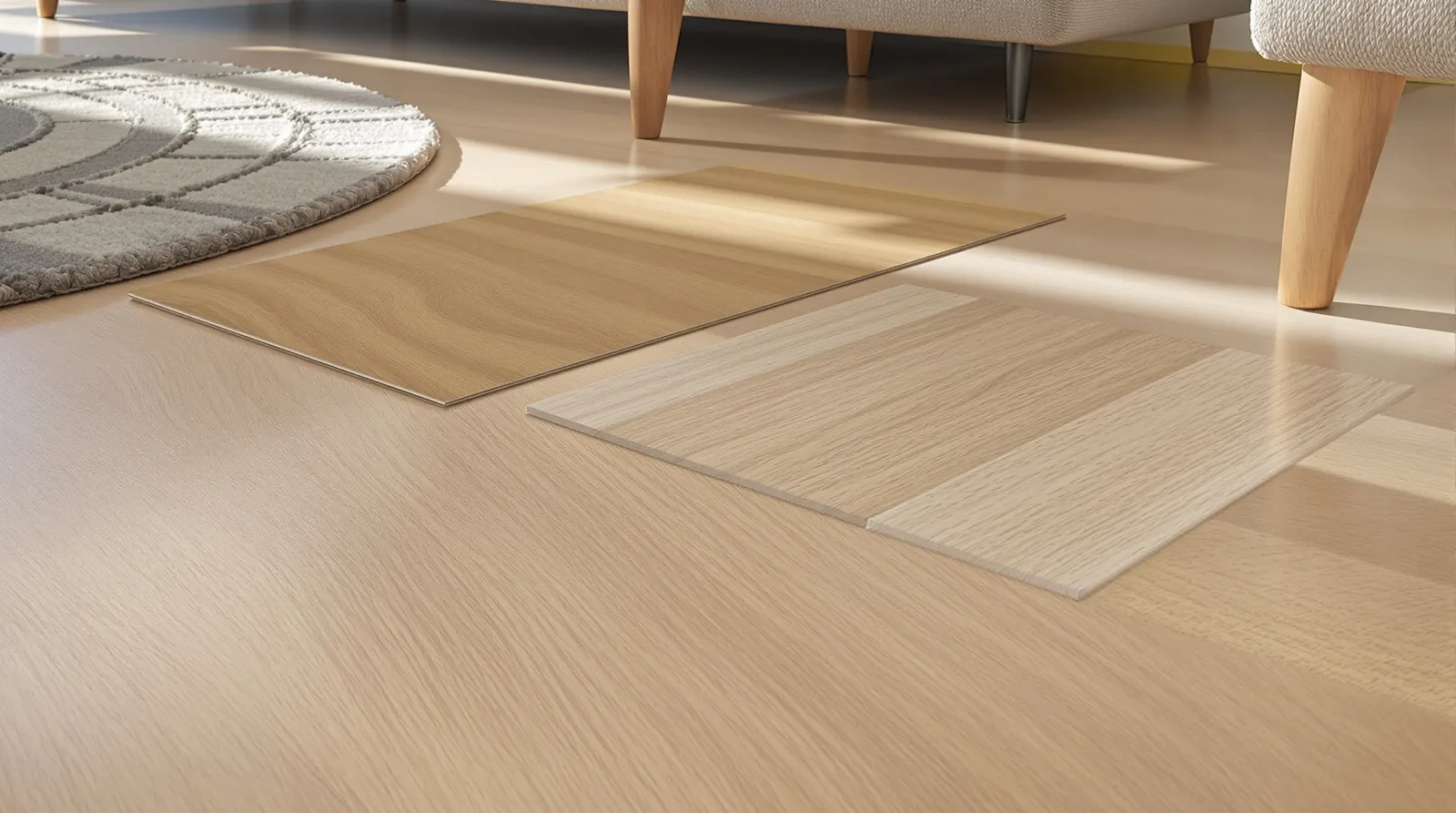
Quick answer
Engineered oak has a real 4 mm oak surface that can be sanded and recoated, feels like timber and can be glued down for a solid sound. Laminate has a printed oak image under a hard overlay, resists scratches better, floats quickly and costs less for the boards, but can't be sanded and is vulnerable to water in its joins.
Engineered oak flooring gives you a real oak surface that can be sanded and recoated, feels like timber underfoot and can be glued down so it sounds solid. Laminate gives you a printed oak image under a very hard overlay. It resists scratches better, floats down quickly and costs less for the boards, but it can’t be refinished and is vulnerable to water in its joins. Neither is right for every home. This guide compares our actual products on the points that matter once the floor is down.
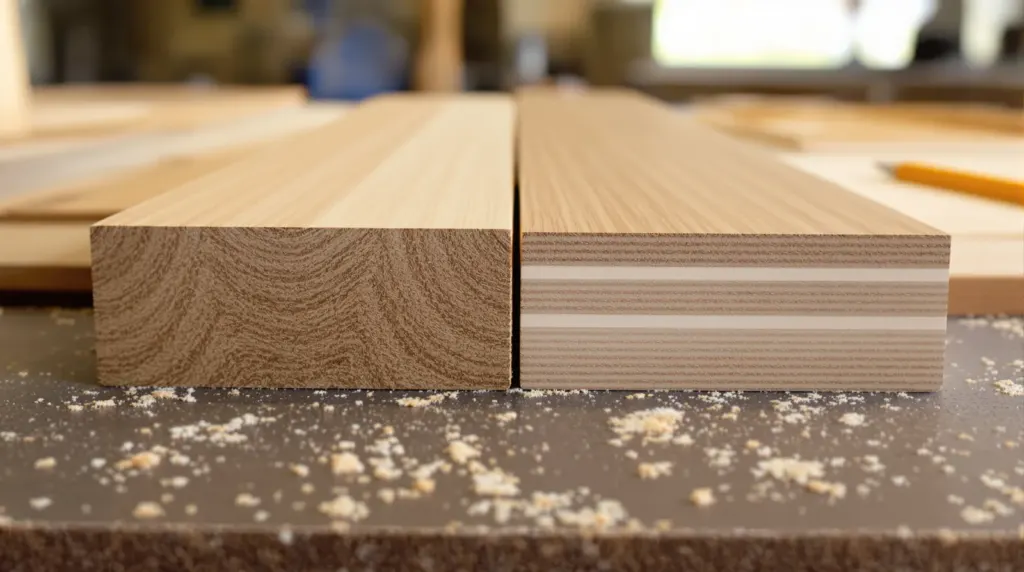
Our engineered oak boards have a 4 mm layer of European oak on top of a layered core, 15 mm thick in total. The surface is brushed, which opens the grain slightly so you can feel it, and finished in a matte coat. Every board is cut from a different piece of oak, so no two are the same.
Our laminate is a 12 mm board with a fibreboard core, a printed image of timber grain and a clear, hard melamine-based overlay. The surface is 4D embossed-in-register, which means the texture pressed into it follows the printed grain. It looks and feels far more convincing than older flat laminates. The image is still printed, though, so the same patterns repeat across a room.
| Engineered oak (standard plank) | Engineered oak (wide board) | Laminate | |
|---|---|---|---|
| Board size | 1900 × 190 × 15 mm | 2200 × 220 × 15 mm | 2260 × 236 × 12 mm |
| Surface | 4 mm real oak, matte brushed | 4 mm real oak, matte brushed | Printed decor, 4D EIR overlay |
| Joint | Tongue and groove | Tongue and groove | Välinge 5G click |
| Install | Glued or floated, depending on job | Glued or floated, depending on job | Floating only |
| Per pack | 6 boards, 2.166 m² | 6 boards, 2.904 m² | 4 boards, 2.13 m² |
| Sand and recoat | Yes, within the wear layer | Yes, within the wear layer | No |
| Example | Natural Oak | Natural Oak wide board | Bellagio Oak |
One detail that is easy to miss: our laminate board is actually longer and wider than our standard oak plank. So if you want long, wide boards on a tighter budget, laminate can give you a similar proportion.
Laminate clicks together and floats on underlay. On a flat, prepared subfloor it goes down quickly, and you can walk on it as soon as it is laid. Because it floats, heavy fixed joinery such as a kitchen island shouldn’t sit on top of it.
Engineered oak with tongue and groove joints can be glued to the subfloor or floated, depending on the board, the subfloor and, in apartments, the building’s rules. Gluing takes longer and the adhesive needs time to cure before furniture goes back, but it gives the firmest result. At 15 mm, oak also sits 3 mm higher than our laminate before underlay or adhesive, which can matter at door bottoms and where the floor meets tiles.
This is the difference most people notice first, usually without being able to say why.
An engineered oak floor glued to a slab feels firm and sounds dense, close to a traditional timber floor. Oak also feels slightly warmer and softer to bare feet than a melamine surface. You can feel the brushed grain.
Laminate always floats on an underlay, so it has a lighter, clickier sound in hard shoes. A 12 mm board sounds much better than the thin 7 or 8 mm laminates at the budget end, and a good underlay helps again. That said, if you put the two side by side in the same room and walk across them in shoes, you will hear the difference. Whether it matters to you is a personal preference. Plenty of people never think about it after the first week.
On this point, laminate has the advantage. Its overlay is harder than any timber finish, so chair legs, toys and dog claws that would leave a mark on oak often leave nothing on laminate. The textured surface hides fine scratches well.
Oak is a hardwood, but it will scratch and it will dent. A dropped cast-iron pan or a stiletto heel leaves a mark. The matte brushed finish on our boards hides fine scratches much better than a gloss coat would, and mid tones such as Natural Oak or Light Tan hide dust and wear better than very pale or very dark boards.
The difference is what happens after. A worn oak floor can be buffed and recoated, or sanded back to fresh timber within its 4 mm wear layer. A laminate floor that is worn through or gouged can’t be repaired in place. The damaged board has to be replaced.
Neither floor tolerates standing water. Laminate’s surface copes well with a spill, but if water gets into the joins, the fibreboard core swells and the board can’t be saved. Engineered oak can also be damaged by water left sitting, both in the surface and in the core.
Both are fine in a kitchen where spills are wiped up. Neither is suited to a laundry, a bathroom or a back entry where wet shoes sit. For those rooms, look at hybrid or tiles. If you are choosing between laminate and hybrid for a wetter room, see our hybrid vs laminate guide.
Oak changes colour with light. It usually warms and ambers slowly over the years, and a rug that never moves can leave a lighter patch underneath. Most people like the way oak mellows, but it is worth knowing. Laminate’s overlay protects the printed layer, so it generally holds its colour better in a sunny room. Blinds on strong west-facing windows help either floor.
Engineered oak is built to be refinished. After years of use, a light buff and recoat freshens the surface without removing much timber. If you want to change the colour later, a full sand is possible within the 4 mm wear layer, although you lose the brushed texture when the surface is sanded flat. That makes oak a floor you can keep through several stages of a house’s life.
Laminate lasts well while its surface is intact, and a damaged board can be swapped out, which is easiest near the walls. Keep a few spare boards from the original order for that. Once the whole floor is tired, though, it gets replaced rather than refinished.
On resale, we don’t quote figures, as we aren’t aware of a reliable source for them. What we can say is that real timber is something buyers ask about, and a well-kept oak floor is easy to describe in a listing. A laminate floor in good condition is unlikely to count against a house, although it can’t be described as timber.
Engineered oak makes sense when:
Laminate makes sense when:
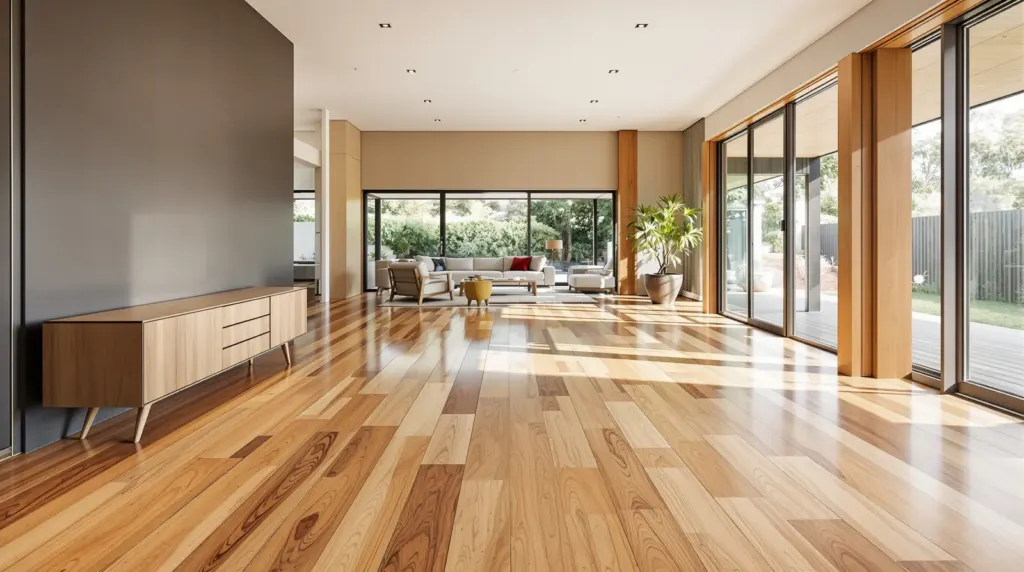
If it is an Australian hardwood look you are after, the same choice applies. Our laminate range includes Australian Blackbutt and two NSW Spotted Gum designs, and our Australian hardwood range has the real species as engineered boards.
Some houses use both: oak in the living areas, laminate in the kids’ rooms or the downstairs rumpus. Match the tones if the floors meet at a doorway.
The best test is simple. Take home a sample of each and put them side by side on the floor where they will go. Walk on them in shoes and bare feet, and look at them in morning and evening light. Samples are free from the showroom at 2/1386 Toorak Road, Camberwell. If you want to know which install method suits your subfloor, you’re welcome to call 1300 690 160 or book a free measure and quote.
Questions
From a distance, often not, especially with a textured laminate like ours. Up close and underfoot, most people can. Real oak has grain that never repeats, it feels slightly softer and warmer, and a glued floor sounds more solid. We suggest putting a sample of each on the floor at home and walking on them.
Laminate resists scratches better, because its overlay is harder than any timber finish. Engineered oak will pick up marks, but a matte brushed surface hides fine ones and the oak can be recoated later. If water bowls and spills are frequent, neither tolerates standing water, so we recommend keeping mats down.
It depends on how long you will stay and what matters to you. If you want real timber that can be refinished in years to come, engineered oak is worth it. For a rental, a rumpus room or a floor you may replace in a decade, laminate is a sensible choice.
Both can work in a kitchen if spills are wiped up promptly. Neither is suited to laundries or areas where water sits. Check the specific product's guidelines before deciding, and put a mat at the sink and dishwasher. For wet areas, look at hybrid or tiles.
Two popular Australian floor timbers compared: how Spotted Gum and Blackbutt differ in colour, grain and variation, and which finish suits your house.
Read the guideHybrid and laminate look alike in the showroom but behave differently at home. Here is how the cores, water resistance, sound and feel compare, room by room.
Read the guideBoth are real timber. The difference is below the surface, and it decides how the floor goes down, how it moves and how many times it can be sanded.
Read the guideFree measure & quote
Let us know your suburb and we will call you to arrange a time. Our quotes are itemised, so you can see the boards, preparation and labour separately.