Spotted Gum vs Blackbutt Flooring: Colour, Grain and Finish Compared
Two popular Australian floor timbers compared: how Spotted Gum and Blackbutt differ in colour, grain and variation, and which finish suits your house.
Read the guide
Quick answer
Choose hybrid where water is a regular risk, such as kitchens, laundries and back entries, because its stone plastic core won't swell. Choose laminate for dry living areas and bedrooms, where its wood-fibre core gives a more solid, warmer feel and a deep textured surface. Neither can be sanded, and both float on underlay.
Hybrid and laminate look almost the same on a showroom wall, and both are floating click floors with a printed timber image under a clear top layer. The difference is the core. Laminate has a wood-fibre core that gives a solid, warm feel but can swell if water gets into the joins. Hybrid has a stone plastic composite core that doesn’t swell, but it reacts more to heat. So choose hybrid where water is a regular risk and laminate for dry living areas and bedrooms. The rest of this guide explains the trade-offs so you can decide room by room.
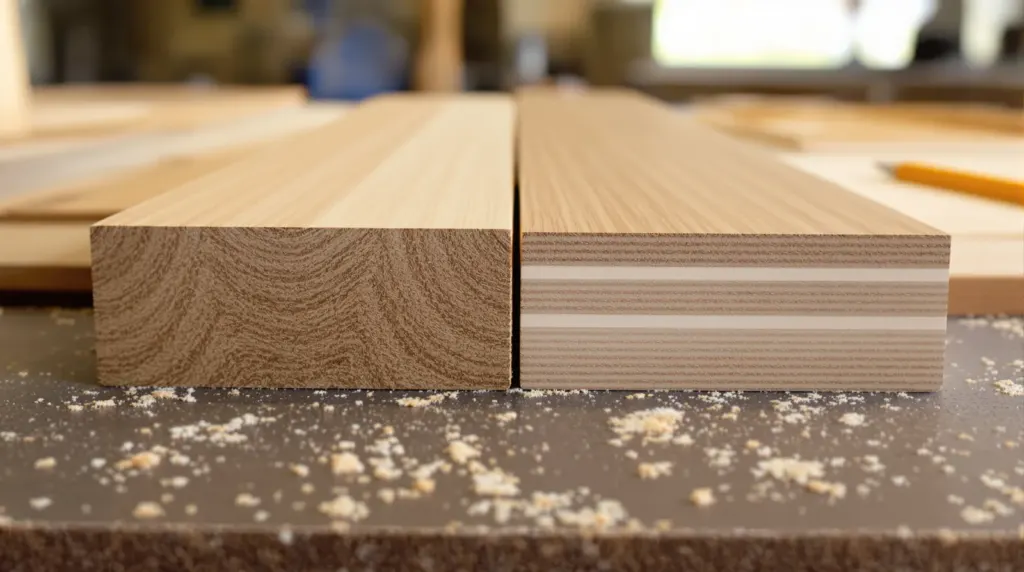
A laminate board has four layers. Underneath is a backing layer that keeps the board from bowing. The core is high-density fibreboard (HDF), wood fibres pressed together under heat and pressure. On top of that sits a printed image of timber grain, protected by a hard, clear melamine-based overlay.
Our laminate range is one construction in eleven designs: 12 mm thick, 2260 × 236 mm boards, with a 4D embossed-in-register surface and a Välinge 5G click joint. Each carton holds four boards and covers 2.13 m². It is always laid floating.
A hybrid board has a rigid core made mainly from ground limestone bound with PVC, called stone plastic composite or SPC. On top is a printed decor layer and a clear wear layer. Many products have an underlay attached to the bottom. The boards click together and float, like laminate.
Specifications vary a lot between hybrid products, so rather than list model specs online, we show our hybrid flooring in the showroom, and you can take samples home to compare with laminate side by side.
| Laminate (our range) | SPC hybrid (general) | |
|---|---|---|
| Core | High-density fibreboard | Stone plastic composite |
| Thickness | 12 mm | Varies by product, usually thinner |
| Surface | 4D embossed-in-register texture over a melamine overlay | Printed decor under a clear wear layer |
| Water | Surface resists spills; core swells if water gets into joins | Core doesn’t swell; water can still reach the subfloor through joins |
| Heat and sun | Fairly stable | Expands with heat; needs gaps and breaks in long runs |
| Feel underfoot | Solid, slightly warmer | Firm, can feel harder and cooler |
| Sanding | Not possible | Not possible |
| Repair | Replace damaged boards | Replace damaged boards |
| Install | Floating on underlay | Floating, often with attached underlay |
Both floors need a flat subfloor. A floating floor flexes over hollows, and over time the click joints in a dip can creak, open or break. That means the same preparation for both: old carpet and grippers out, high spots ground, low spots levelled, and a moisture barrier over a ground-floor slab where the product calls for one.
Height is where they differ. Hybrid boards are usually thinner than our 12 mm laminate, which can matter when you are laying over existing flat tiles, fitting under a door that can’t easily be trimmed, or meeting a kitchen floor that isn’t being replaced. A thicker board plus underlay may need doors trimmed and a reducer trim at the tiles. None of this rules either floor out, but check the finished height at the measure before you choose.
Installation time is similar for the two on a well-prepared subfloor, since both click together and float. The preparation underneath usually decides how long the job takes.
This is the main practical difference between the two floors. If a laminate board sits in water, or water works its way into the joins, the fibreboard core takes it up and swells. Swollen laminate can’t be dried back to flat. The board has to be replaced. The surface itself copes with a spill that is wiped up. The damage comes from water that is left to sit: a leaking dishwasher, a dog bowl that gets knocked over every morning, wet boots at the back door.
An SPC core doesn’t take up water, which is why hybrid is sold as waterproof. That is true of the board, but not of the floor. Water can still get through the joins and around the edges to the subfloor. A flooded laundry or a burst pipe can still mean lifting boards to dry the slab or the timber subfloor underneath.
So in a kitchen where you wipe up spills, either can work, as long as you follow the laminate product’s guidelines. In a laundry, a back entry or a hallway outside a bathroom, hybrid is the better choice. Our hybrid can go in bathrooms and laundries, but not in a shower base or anywhere with regular running water, and neither floor replaces tiles and a waterproof membrane there.
Both are floating floors, so neither sounds like a glued timber floor. Walk across either in hard shoes and you will hear more click than thud.
A 12 mm laminate board has a thick core, and it feels more solid and sounds less hollow than the thin laminates at the budget end. Many people also find laminate a little warmer to bare feet. Hybrid boards are dense and rigid, and some can sound slightly hollow, depending on the underlay. An attached underlay helps, and a good separate underlay helps more.
In an apartment, sound is also a matter of building rules. Most owners corporations set acoustic requirements for hard floors, and the underlay has to meet them. We recommend checking your building’s rules before you choose either floor. Our guide to soundproof flooring for apartments covers this.
SPC expands and contracts with temperature. Behind a big west-facing window on a hot Melbourne afternoon, hybrid boards in direct sun warm up and grow slightly. Without enough expansion gap, or across a long unbroken run through several rooms, the joins can peak or lift. The fix is in the installation: correct gaps at every wall, a break with a trim at doorways or in very long runs, and blinds on the hottest windows.
Laminate is less sensitive to heat but moves with humidity, so it still needs expansion gaps. It is generally the easier of the two for a long open-plan floor running into a sunny living room.
Laminate’s melamine-based overlay is very hard, and the textured surface on our boards hides fine scratches well. That makes it one of the better choices with dogs, as long as water bowls sit on a mat. Hybrid scratch resistance depends on each product’s wear layer and coating, so test samples rather than trusting a label.
Neither floor can be sanded. The timber look is a printed image, and once the top layer is worn or gouged through, that board is replaced. Boards near the walls are the easiest to swap. Keep a few spare boards from your original order, because a later batch may not match exactly.
If you are still deciding whether you want a printed floor at all, our comparison of engineered oak vs laminate sets out what you gain with real timber.
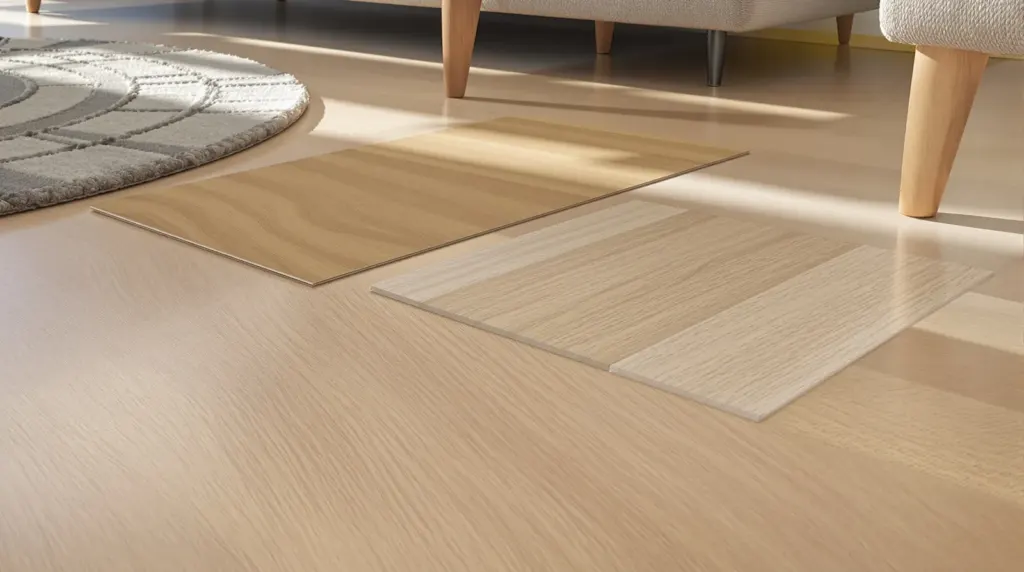
The quickest way to decide is to hold a laminate sample and a hybrid sample next to each other, knock on them, and scratch them with a key. You’re welcome to visit the showroom at 2/1386 Toorak Road, Camberwell, and take both home to try in the room they are for. To find out which suits your subfloor, you can book a free measure and quote or call us on 1300 690 160.
Questions
Laminate's melamine-based overlay is very hard and resists scratching well. Hybrid scratch resistance depends on the wear layer and coating of each product, and it varies more. Take a sample of each home and try a key on the back corner. This usually tells you more than the label.
Often, yes, provided spills are wiped up promptly. The surface handles water, but the wood-fibre core can swell if water sits in the joins. Check the specific product's guidelines for kitchens. For laundries and anywhere water sits regularly, hybrid or tiles are the safer choice.
Not necessarily. Both are floating floors and can sound hollow or clicky in hard shoes. A thicker laminate board, like our 12 mm, tends to feel and sound more solid. With hybrid, the attached or separate underlay makes the biggest difference. In apartments, the underlay must meet the building's acoustic rules.
Yes, and it can make sense: laminate through the living areas and bedrooms, hybrid in the laundry and back entry. The two will look different up close, so plan the change at a doorway with a trim rather than in the middle of an open room.
It can. SPC expands with heat, so boards in full summer sun behind large west or north-facing windows expand slightly. Correct expansion gaps, breaks in long runs and blinds on hot windows prevent the joins peaking. Laminate is less affected by heat but more affected by moisture.
Two popular Australian floor timbers compared: how Spotted Gum and Blackbutt differ in colour, grain and variation, and which finish suits your house.
Read the guideBoth are real timber. The difference is below the surface, and it decides how the floor goes down, how it moves and how many times it can be sanded.
Read the guideReal oak or a printed oak look? A side-by-side of our engineered oak and laminate on feel, noise, scratches, water and what happens when a board gets damaged.
Read the guideFree measure & quote
Let us know your suburb and we will call you to arrange a time. Our quotes are itemised, so you can see the boards, preparation and labour separately.