Spotted Gum vs Blackbutt Flooring: Colour, Grain and Finish Compared
Two popular Australian floor timbers compared: how Spotted Gum and Blackbutt differ in colour, grain and variation, and which finish suits your house.
Read the guide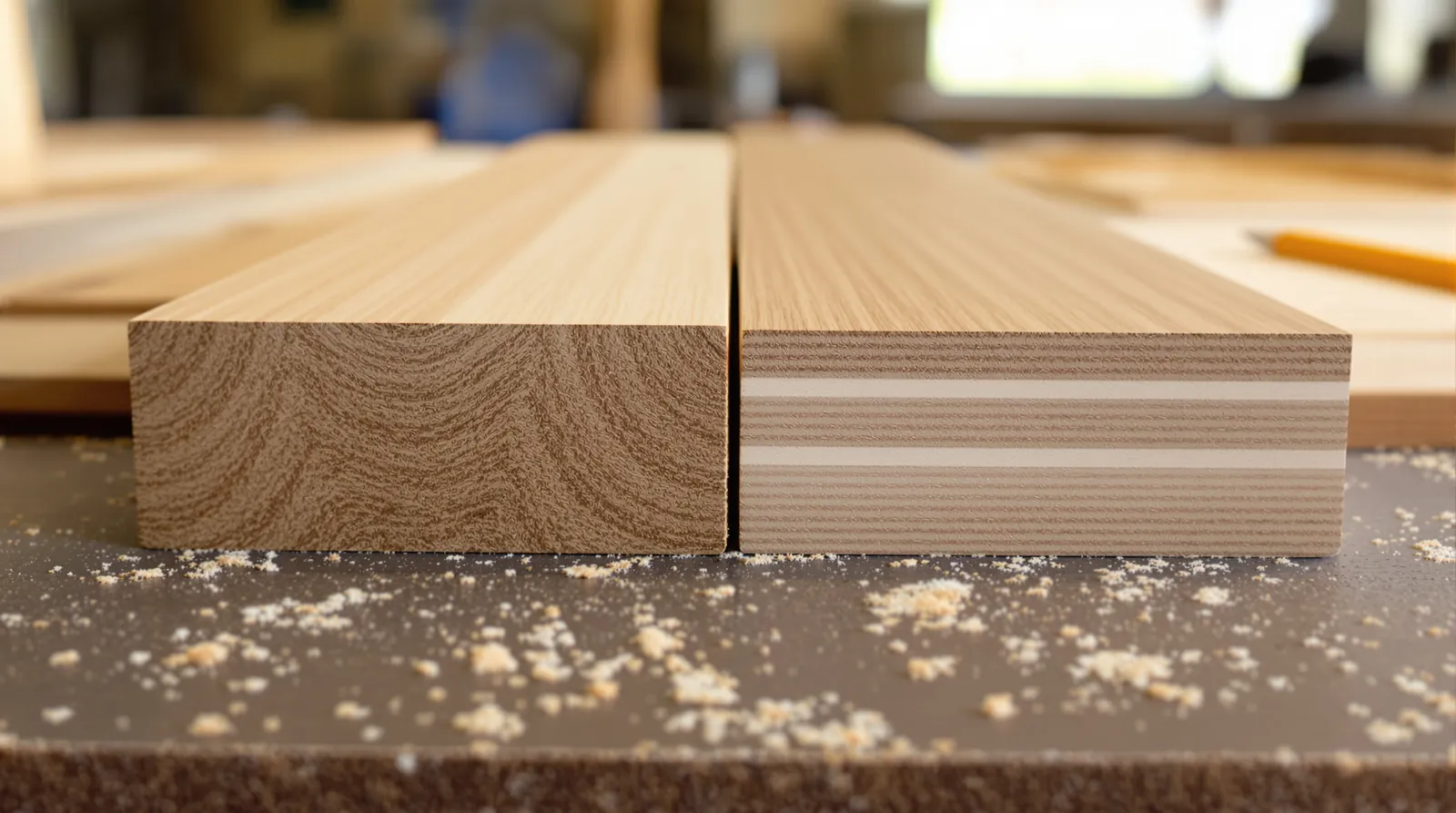
Quick answer
Solid timber is one piece of wood through the full board. Engineered timber has a real timber wear layer bonded to a stable layered core. Solid can be sanded more times over its life. Engineered moves less, suits slabs, wide boards and many heating systems, and arrives pre-finished. Both are real timber underfoot.
Solid timber flooring is one piece of wood through the full thickness of the board. Engineered timber has a layer of real timber on top, bonded to a stable core made of cross-laid layers. You see and walk on real timber either way. The difference is underneath, and it decides how the floor goes down, how much it moves through the seasons, and how many times it can be sanded. Both our engineered oak and our Australian hardwood boards are engineered. This guide explains what that means and when solid still makes sense.
A solid floorboard is sawn from one piece of timber. Traditional Australian hardwood floors in older Melbourne houses are solid tongue-and-groove boards, commonly around 19 mm thick, nailed straight to the joists. They are usually laid raw and sanded and coated on site once they are down.
An engineered board has a top layer of real timber, called the wear layer, bonded to a core of layers laid with their grain running in different directions. That cross-laid core resists the swelling and shrinking that a solid board goes through as humidity changes. The boards arrive with the finish already applied.
Our engineered oak is 15 mm thick with a 4 mm European oak wear layer, micro bevelled, tongue and groove, with a matte brushed finish. Our Australian hardwood boards in Blackbutt, Spotted Gum and Victorian Ash are 14 mm thick with a 3 mm hardwood wear layer, also tongue and groove. We mention this because the word “solid” is sometimes used loosely for any real-timber floor. Our oak is engineered. Our Australian hardwood comes both as 14 mm engineered boards and as 18 mm solid tongue-and-groove boards, which arrive prefinished.
| Engineered | Solid | |
|---|---|---|
| Construction | Real timber wear layer on a layered core | One piece of timber throughout |
| Our range | Oak 15 mm with 4 mm wear layer; hardwood 14 mm with 3 mm wear layer | 18 mm tongue-and-groove, prefinished |
| Movement with humidity | Less | More |
| Finish | Applied in the factory | Usually sanded and coated on site |
| On a concrete slab | Glued down or floated | Glued down or fixed to battens |
| Wide boards | Practical, such as our 220 mm wide oak | Wider boards carry more cupping risk |
| Sanding over its life | Limited by the wear layer | Several times, down to the tongue |
| Time before you can use the room | Shorter, no on-site coating | Longer, coats need drying time |
This is the main advantage of solid timber. A solid board can be sanded back to fresh timber several times over its life, down to the point where the tongue and groove is exposed. That is why so many original Melbourne floors from the early 1900s can still be sanded and polished today.
An engineered board can only be sanded within its wear layer. A 4 mm oak layer leaves real timber to work with, and a 3 mm hardwood layer less so. Both allow a sand and recoat, though fewer times than a full solid board. Thin-veneer engineered floors, the kind with 1 to 2 mm on top, may allow one light sand or none.
In practice, most floors never get a full sand. After years of use the usual job is a buff and recoat, which takes off very little timber. So the question to ask yourself is how long you plan to keep the floor, and whether you are likely to want to change its colour later. Our guide on sanding engineered timber covers this in more detail.
Most of the difference in practice comes down to what you are laying on.
On a concrete slab, engineered boards are usually the easier choice. They can be glued straight to a flat, moisture-tested slab, or floated over underlay where that suits the board and the building. Solid boards on a slab are generally glued down or fixed to battens, and they are more sensitive to any moisture coming up through the concrete. So many newer Melbourne houses, townhouses and extensions are built on slabs, which goes a long way to explaining why engineered floors are now so common.
On joists, in an older house on stumps with the original floor removed, solid boards are the traditional fit. They span the joists and are nailed down. Engineered boards need a continuous base, so they usually go over existing boards or sheet flooring rather than straight onto joists.
Over an existing timber floor, a 14 or 15 mm engineered board adds less height than a solid board of around 19 mm. That can matter at the back door, the bottom stair, and where the new floor meets tiles. For more on laying over concrete, see our guide to a timber floor on a concrete slab.
All timber takes on and gives off moisture with the air around it. In a Melbourne winter with the heating running, indoor air gets dry and boards shrink slightly, which can open fine gaps. In a humid summer they swell and the gaps close. A solid board moves more than an engineered one, and a wide solid board moves more again, which is why wide solid boards can cup.
The layered core of an engineered board restrains that movement. That is why engineered oak can be made much wider than a solid board of similar stability. Our wide board, like Natural Oak wide board, is 2200 × 220 mm. Engineered boards still move a little, so every installation needs an expansion gap around the edges.
If you have hydronic or electric heating in the slab, engineered boards are generally the better fit, because they move less with temperature changes. Every product has its own limits, though, including maximum surface temperature and how the heating is started up after installation. We recommend checking the specific board against your system before you order.
An engineered floor arrives pre-finished. Once it is down and any adhesive has cured, you can use the room. There is no on-site sanding dust and no waiting for coats to dry.
A traditional solid floor is usually laid raw, then sanded and coated on site. That adds days to the job, and the rooms stay empty while the coats dry. The upside is that the finish is applied as one continuous coat over the whole floor, and you choose the sheen and stain on site.
Underfoot, a glued engineered floor feels firm and sounds close to a traditional timber floor. A floated engineered floor sounds a little different, with more of a click in hard shoes, and the underlay makes a big difference. A solid floor nailed over joists has the familiar sound of an older house, and it can develop the odd squeak as nails loosen over the decades. There is no right or wrong here. It is worth standing on each type if you can, because people have strong preferences once they have heard the difference.
Either way, the boards need to settle to the conditions in your house before installation, and the subfloor needs the same checks for flatness and moisture.
Engineered is usually the better choice if:
Solid is worth asking about if you are restoring an older house on stumps, want to match or replace an existing solid floor, or plan to keep the floor for many decades and sand it more than once. In that case, ask about our 18 mm solid tongue-and-groove boards for your species and rooms.
If you like the look of Australian hardwood, compare Blackbutt smooth with our oak boards on the showroom wall. The species matters as much to how the floor looks as the construction does.
It helps to tell us what your subfloor is, whether there is heating, and how long you plan to stay in the house. Those three answers usually settle the choice. You’re welcome to visit the showroom at 2/1386 Toorak Road, Camberwell, or call 1300 690 160 to book a free measure and quote.
Questions
Yes. The surface you see and walk on is real timber. On our engineered oak it is a 4 mm European oak wear layer, and on our Australian hardwood boards it is a 3 mm layer of Blackbutt, Spotted Gum or Victorian Ash. The layers underneath are there for stability, not looks.
We aren't aware of a reliable source showing that buyers pay more for one than the other. What buyers notice is whether a floor is real timber and whether it is in good condition. Both engineered and solid boards are real timber, so choose the one that suits your subfloor and plans.
It can, but it takes more work. Solid boards are traditionally nailed to joists, so on a slab they are usually glued down or fixed to battens, and the slab has to be dry and flat. Engineered boards are generally simpler on a slab, which is one reason they are common in newer homes.
Yes. We supply 18 mm solid tongue-and-groove boards as well as engineered boards. The solid range covers Spotted Gum, Blackbutt, Grey and Red Ironbark, Tallowwood, Kempas and Jatoba. If you let us know the rooms and your subfloor, we can recommend which suits.
Engineered boards are generally the better fit, because the layered core moves less with changes in temperature and moisture. It still depends on the specific product and heating system, so check the manufacturer's limits before choosing. Please mention the heating at the measure.
Two popular Australian floor timbers compared: how Spotted Gum and Blackbutt differ in colour, grain and variation, and which finish suits your house.
Read the guideHybrid and laminate look alike in the showroom but behave differently at home. Here is how the cores, water resistance, sound and feel compare, room by room.
Read the guideReal oak or a printed oak look? A side-by-side of our engineered oak and laminate on feel, noise, scratches, water and what happens when a board gets damaged.
Read the guideFree measure & quote
Let us know your suburb and we will call you to arrange a time. Our quotes are itemised, so you can see the boards, preparation and labour separately.