Spotted Gum vs Blackbutt Flooring: Colour, Grain and Finish Compared
Two popular Australian floor timbers compared: how Spotted Gum and Blackbutt differ in colour, grain and variation, and which finish suits your house.
Read the guide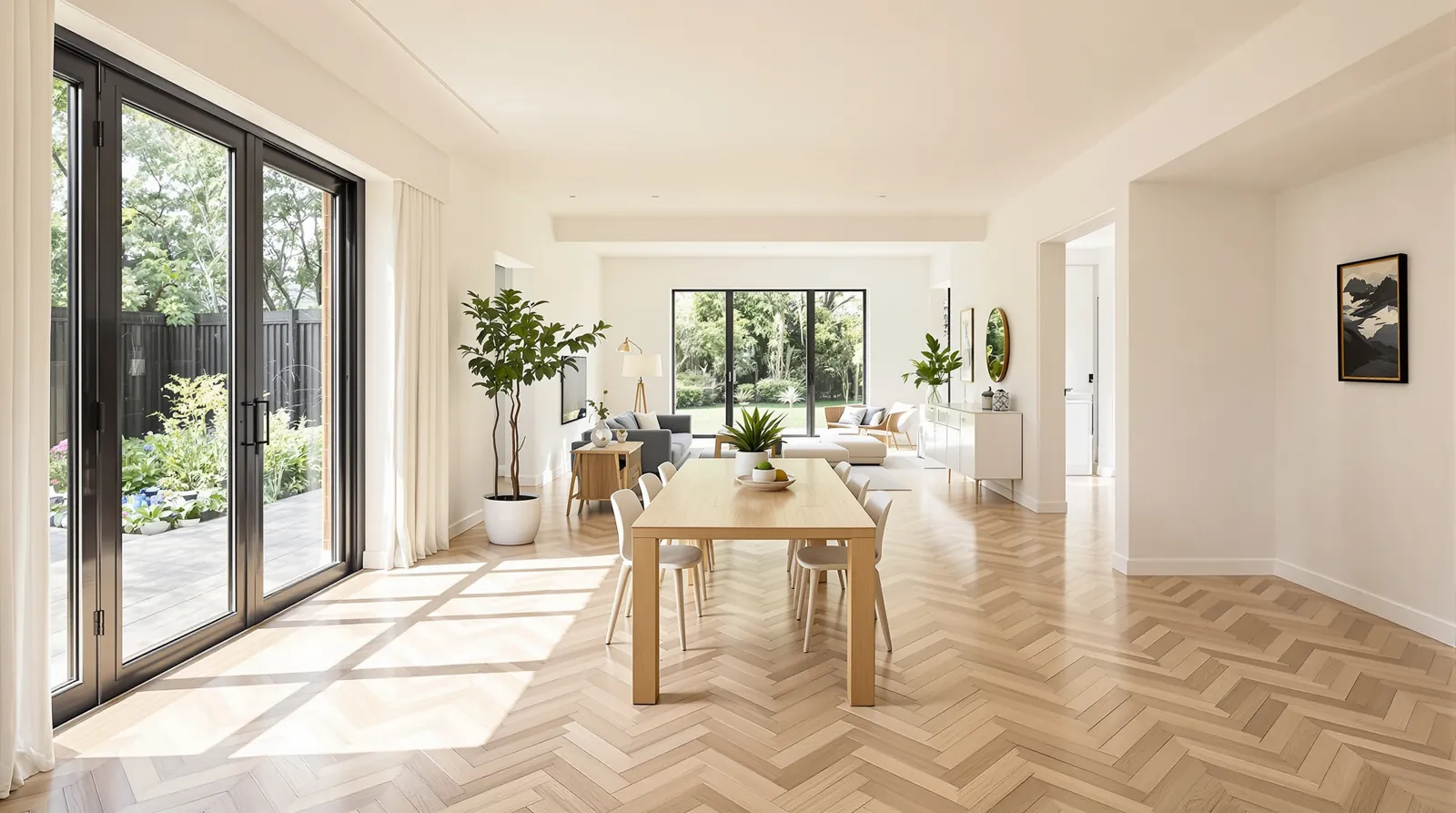
Quick answer
Herringbone uses rectangular blocks with square ends, laid so each end butts against the side of the next block, giving a stepped, woven zigzag. Chevron uses blocks with angled ends that meet in a clean point, giving a continuous V. Herringbone feels relaxed and suits most rooms; chevron looks sharper and more formal.
Herringbone and chevron both make a zigzag across the floor, and the difference is at the ends of the blocks. Herringbone uses rectangles with square ends, so each block butts against the side of its neighbour and the pattern steps along like woven fabric. Chevron uses blocks with ends cut at an angle, so they meet in a clean point and form a continuous V. Herringbone looks a little softer and suits almost any room. Chevron looks sharper and more directional. We stock both: engineered oak herringbone and engineered oak chevron.
Look at where two blocks meet at the tip of the zigzag.
From across a room, herringbone has more texture and movement, because the stepped joins break up the lines. Chevron has cleaner, stronger lines, and the eye follows the points straight down the room.
A quick test when you are saving photos online: follow one row of blocks with your finger. If your finger has to jog sideways at every tip, it is herringbone. If it runs straight into a clean point, it is chevron. Plenty of photos are labelled wrongly, so it is worth checking before you show an installer.
Herringbone is the more forgiving of the two. The stepped joins soften the pattern, so it sits comfortably in a Victorian hall, a 1930s front room or a new open-plan extension. With big blocks, like our 900 × 150 mm oak, it looks bolder and calmer than the small-block parquetry in older floors. In a busy room with rugs and furniture, it holds its own without overpowering the space.
Chevron is more graphic. The continuous V points in one direction very clearly, so it works best where you want to pull the eye somewhere: down a long hallway, towards a fireplace, or out to the garden. It suits rooms with less going on. In a room with a lot of furniture and pattern already, chevron can feel like too much. In a spare, well-lit space, it is striking.
Both patterns make a room look longer when they run along its length. Chevron does it more strongly, which works well in a long room but can feel exaggerated in a short one.
| Herringbone | Chevron | |
|---|---|---|
| Block ends | Square | Angled |
| Where blocks meet | End against the side of the next block | End to end, in a point |
| Look | Stepped, woven, softer | Continuous V, sharper |
| Best in | Most rooms, period and modern | Long, simple, well-lit spaces |
| Fitting | Blocks interlock at right angles | Angled ends have to meet precisely along every row |
| In our range | Engineered oak, 900 × 150 × 15 mm and 600 × 120 × 15 mm | Engineered oak, 915 × 155 × 15 mm and 600 × 90 × 15 mm |
The same pattern can look very different depending on the block. Our larger herringbone blocks are 900 mm long and 150 mm wide, six times as long as they are wide. Long, slim blocks stretch the zigzag out, so each “arm” of the pattern is long and the floor looks calmer. Shorter, squatter blocks make a tighter, busier zigzag, closer to the parquetry you see in older houses.
Chevron blocks vary in the angle of their ends as well as their size. The ends are commonly cut at 45 degrees, which gives a V similar in width to a herringbone. A steeper or shallower angle makes the V narrower or wider. If you are ordering chevron, ask to see a laid-out sample at the angle you are considering, because the angle changes the look more than people expect.
Double herringbone lays two blocks side by side in each arm of the pattern instead of one. It uses the same blocks as standard herringbone and gives a wider, bolder zigzag that suits large rooms. It takes more setting out, so it adds to the labour.
Both patterns are almost always glued down, and both need a very flat subfloor, because short blocks show every dip. Both are set out from a centre line, and both need more cutting at the walls than straight plank. Beyond that, a few things differ.
The joins down the middle. In chevron, every angled end has to meet its partner exactly along the centre of each row. A small error shows as a crooked line of points down the room. Herringbone’s stepped joins are more forgiving of tiny variations.
Left and right blocks. Pattern floors with tongue and groove joins are generally made in left-hand and right-hand versions, so the tongues face the right way on each side of the zigzag. That is normal and is handled when the floor is ordered and laid.
Availability. Both patterns are in our range, so you can ask for samples of either. Chevron sizes or colours outside the range are made to order, with longer lead times, so please speak with us before you lock in a start date.
Refinishing. Sanding any pattern floor means working across grain that changes direction every block. It is a job for someone experienced with pattern floors. Our herringbone has a 4 mm oak wear layer, which leaves room for a sand and recoat in future.
Some general guidance, based on what we see in eastern suburbs homes:
Colour changes the effect too. A pale floor like White Smoke herringbone quietens the pattern. A warm tone like Caramel Sundae herringbone brings it forward. Very dark tones show the pattern strongly and show dust more.
You rarely need a pattern floor in every room. Many houses use the pattern in the hall, living or dining room, and straight plank through the bedrooms and kitchen. The six colours of our 900 × 150 mm herringbone also come as standard plank, so the colour carries through the house and only the pattern changes. Plan where the pattern stops: at a doorway with a threshold, or with a border across an open room so the change looks deliberate.
A pattern floor also costs more to lay than plank, because of the set-out, the number of pieces and the cutting at every edge. Our herringbone cost guide explains where that extra goes. Keeping the pattern to the rooms where it gets seen is the simplest way to manage it.
If you are leaning towards chevron, start with the six chevron colours on our herringbone and chevron page. If you need a size or colour outside them, have these answers ready: the rooms and approximate area, the colour you like, the block size and angle you have in mind, whether you want a border, and your ideal start date. That helps us check with suppliers quickly and let you know what is achievable.
Look at both patterns laid out at full size before you decide. Photos make the difference look smaller than it is. Our herringbone is on the wall displays in the showroom, and the full range is on the herringbone and chevron page. If you have decided on chevron, please bring your plans and we will lay out samples of both. You’re welcome to visit 2/1386 Toorak Road, Camberwell, or call 1300 690 160.
Questions
Not necessarily. Both patterns have a long history in European floors. Chevron tends to look crisper and more graphic, which is why it often turns up in contemporary interiors, while herringbone can look traditional or modern depending on the block size and colour. Larger blocks in a pale oak read as modern in either pattern.
Yes. We carry engineered oak chevron in 915 × 155 mm blocks (four colours) and 600 × 90 mm blocks (two colours), alongside engineered oak herringbone in 900 × 150 mm and 600 × 120 mm blocks. Other chevron sizes can be sourced to order, which takes longer, so please ask us early in your project.
Either, if it runs along the length of the room. The zigzag draws the eye in the direction it points, so a long hall or open living area looks longer. Chevron does this more strongly because its V is continuous. Running either pattern across a narrow room makes it look wider but busier.
You can, but two different pattern floors in the same house usually compete with each other. Most people pick one pattern for the feature rooms and use straight plank in the same colour elsewhere. If you want both, keep them apart, with a plank room or a clear doorway between.
Two popular Australian floor timbers compared: how Spotted Gum and Blackbutt differ in colour, grain and variation, and which finish suits your house.
Read the guideHybrid and laminate look alike in the showroom but behave differently at home. Here is how the cores, water resistance, sound and feel compare, room by room.
Read the guideBoth are real timber. The difference is below the surface, and it decides how the floor goes down, how it moves and how many times it can be sanded.
Read the guideFree measure & quote
Let us know your suburb and we will call you to arrange a time. Our quotes are itemised, so you can see the boards, preparation and labour separately.