Wide Plank Oak Flooring: Pros, Cons and When It Makes Sense
Wide boards look calmer in big rooms but ask more of the subfloor. How 2200 × 220 mm oak compares with a standard plank, with a worked room example.
Read the guide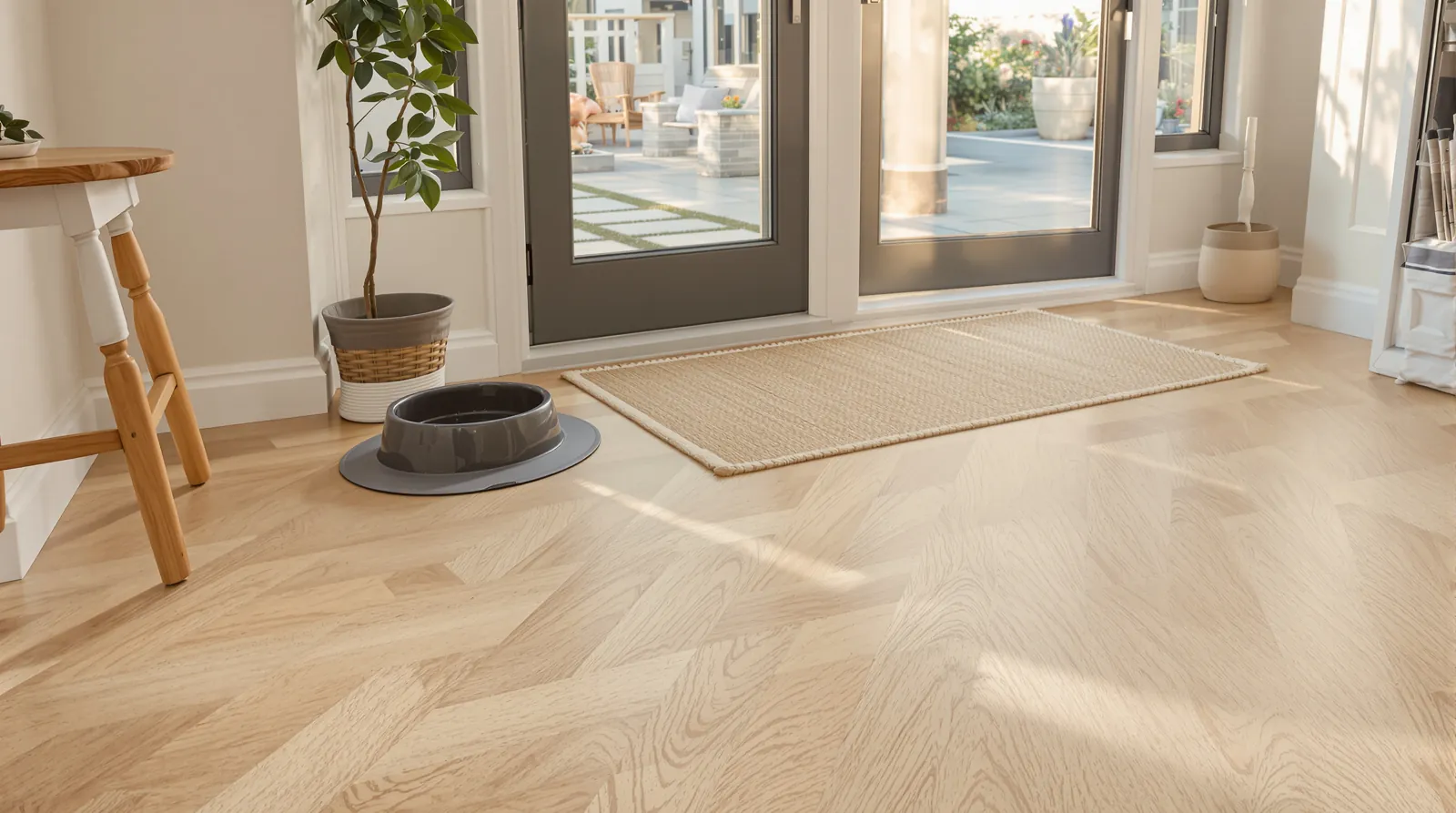
Quick answer
No floor is scratch-proof. Laminate and hybrid resist scratches better than timber, and hybrid handles water best. If you want real timber, choose a hard species or oak with a matte brushed surface in a mid tone, which hides fine marks and hair. Water bowls and accidents do more damage than claws, so manage moisture first.
No floor is scratch-proof, so the best flooring for dogs depends on which matters more to you: avoiding marks, or having real timber rather than a printed floor. If scratches would bother you, laminate or hybrid resist them better than any timber. If you want real timber, choose a hard species or oak with a matte brushed surface in a mid tone, and expect it to pick up some character over time. Finish and colour matter more than most people expect, and water matters more than claws.
It helps to separate the kinds of damage, because each floor handles them differently.
Scratches are cosmetic, whereas moisture damage is not. This is the most important point on this page.
A scratch shows because it catches light differently from the surface around it. On a smooth, glossier finish, every fine line stands out against the even sheen. On a matte brushed surface, the texture already breaks up the light, so the same scratch mostly disappears into it.
All our engineered European oak boards have a matte brushed surface. Our Australian hardwoods come in two finishes: a smooth surface with a 10% gloss level, and matte brushed. For a house with a dog we would recommend the brushed versions, such as Blackbutt matte brushed and Spotted Gum matte brushed. They are the same timbers as the smooth boards, with a surface that copes much better with paw traffic.
Hardness still counts for dents. Blackbutt and Spotted Gum are hard Australian species and hold up well to everyday wear. Victorian Ash is softer and marks more easily, so it is a better fit for a bedroom than for a hallway that a large dog runs along ten times a day.
It may sound unusual, but this is one of the most practical suggestions we can offer. Very dark floors show pale hair, dust and paw prints within hours. Very pale floors show dark hair and muddy prints. A scratch through a dark stained surface can also show a lighter line underneath.
Mid tones are the most forgiving. A floor like Natural Oak or anything on our warm browns page hides hair, crumbs and fine marks better than either extreme. If your dog sheds heavily and has a distinctly light or dark coat, it helps to lean the floor slightly towards that colour.
| Floor | Scratches | Water and accidents | If it gets damaged |
|---|---|---|---|
| Engineered oak, matte brushed | Fine scratches blend into the texture; dents possible | Fine if wiped up; liquid left sitting will mark | 4 mm wear layer allows recoating and sanding later |
| Engineered Blackbutt or Spotted Gum, matte brushed | Harder timber, better at resisting dents | Same as oak | 3 mm wear layer allows recoating and limited sanding |
| Hardwood, smooth 10% gloss | Scratches show more | Same as oak | Same as brushed |
| Laminate, 12 mm | Hard overlay resists scratching well | Water in the joints swells the core | Can’t be sanded; damaged boards are replaced |
| Hybrid | Generally resists scratching well | Core doesn’t swell with water | Can’t be sanded; boards are replaced |
Our laminate is 12 mm with a textured surface that follows the printed grain, laid floating on a click joint. For hybrid, we have samples in the showroom and can talk you through them. Our comparison of hybrid vs laminate flooring goes into how the two differ.
Most of the dog-related damage we see comes from water rather than claws: a dark patch under the water bowl, or a swollen edge by the back door where a wet dog comes in every evening.
If you are toilet-training a puppy, it may be worth holding off on a new timber floor in the rooms it uses most, or choosing hybrid for those rooms. We understand that isn’t always welcome news, but it can save a new floor.
Keeping claws trimmed reduces scratching more than any product choice, and your vet or groomer can show you how short is right for your dog.
Think about grip too. Any hard floor is more slippery for a dog than carpet, and older dogs or breeds with joint problems can struggle on a smooth surface. A brushed or textured surface gives a little more feel than a smooth one, but rugs with a non-slip backing along the routes your dog uses are the most effective solution. If the dog goes up and down stairs, consider runners or treads with grip.
We also recommend felt pads under furniture. Dogs knocking into chairs and tables cause as many scrapes as their claws do.
A dog means more vacuuming, and on a hard floor that is a good thing: you can see the hair and grit and get it off, instead of it working into carpet. Use a vacuum with a hard-floor head or a soft brush, not a beater bar, which can mark the finish. On a brushed oak surface, the brush attachment lifts dirt out of the texture better than a flat head.
Mop with a damp, well-wrung mop and a cleaner made for your floor’s finish. On laminate, keep the mop barely damp, because the joints are the weak point. On timber, avoid oil soaps, wax and anything that leaves a residue, since a slippery film makes the floor harder for an excitable dog to grip.
Check the felt pads on chairs every few months. Dog hair and grit collect in them and turn a protective pad into something closer to sandpaper. Our care guide covers the routine for each floor type.
These are starting points rather than rules, as every house and every dog is different.
Take a few samples home and live with them for a few days. Leave them where the dog walks and by the back door, and look at them in the morning and at night. You will soon see how each surface handles hair, paw prints and light. Samples are free from our Camberwell showroom at 2/1386 Toorak Road. You’re welcome to tell us about your dog when you visit or call 1300 690 160, and we will help narrow the range down to the boards that suit.
Questions
Yes, over time. Most of those marks are fine scratches in the finish rather than damage to the wood, and a matte brushed surface hides them well. Deeper dents come from skidding or dropped objects. Keeping claws trimmed and putting mats at the doors makes the biggest difference.
Both resist scratching better than timber; the main difference is how they handle water. Laminate has a wood-fibre core that can swell if liquid gets into the joints, so accidents and water bowls need care. Hybrid has a core that doesn't swell with water, which suits puppies and wet paws better.
Of our range, Spotted Gum and Blackbutt are the harder species and cope better with dents than oak or Victorian Ash. Choose the matte brushed versions rather than the smooth 10% gloss boards, because the brushed texture hides fine claw marks much better.
Light wear in the finish can often be dealt with by a buff and recoat rather than a full sand. Deeper marks may need sanding, which engineered boards allow within the limits of their wear layer. Laminate and hybrid can't be sanded, so damaged boards are replaced instead.
Wide boards look calmer in big rooms but ask more of the subfloor. How 2200 × 220 mm oak compares with a standard plank, with a worked room example.
Read the guideNo hard floor is soundproof. What reduces noise to the apartment below, how owners corporation rules work, and choosing board and underlay as a pair.
Read the guideHow to get the most out of a visit to our Camberwell showroom when you are choosing an oak floor: what to bring, what to ask and how to judge samples at home.
Read the guideFree measure & quote
Let us know your suburb and we will call you to arrange a time. Our quotes are itemised, so you can see the boards, preparation and labour separately.