Herringbone Flooring in Kew: Planning the Pattern for Your House
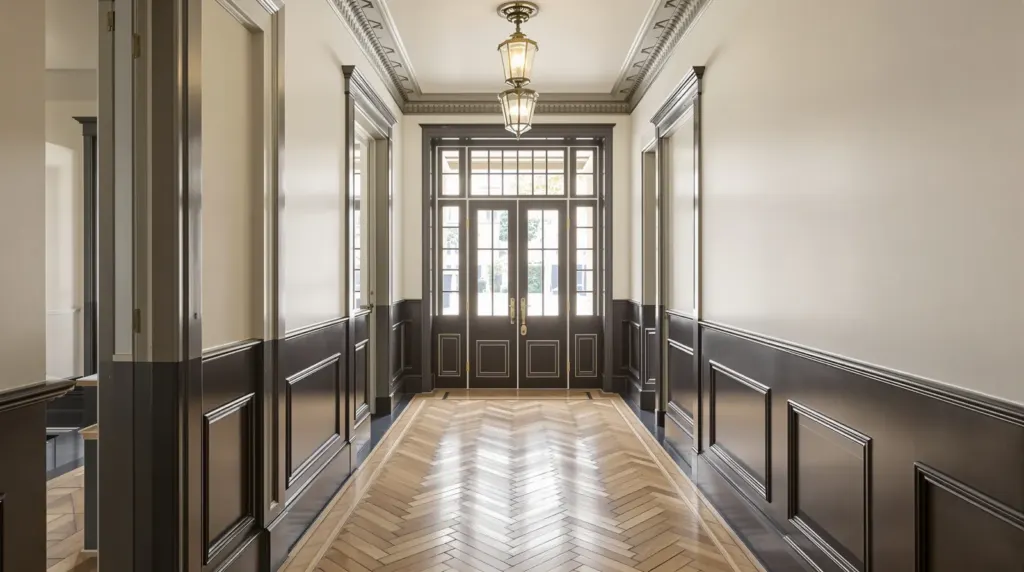
How to plan herringbone in a Kew house: pattern direction in long halls, borders around fireplaces and old walls, colour choice and the extra material to order.
Read the guide
Quick answer
Blackbutt is a good fit for Deepdene's Californian bungalows and interwar homes: a pale, even Australian hardwood that sits well with original joinery. Ours is a 14 mm engineered board with a 3 mm Blackbutt wear layer, in smooth 10% gloss or matte brushed. Choose Spotted Gum for busier rooms and Victorian Ash for a lighter, straighter grain.
Blackbutt is a very good fit for a Deepdene bungalow or interwar home. It is a pale, fairly even Australian hardwood that sits comfortably with original timber joinery, leadlight and fireplaces without making the house look new. Ours is a 14 mm engineered board with a 3 mm Blackbutt wear layer, 180 mm wide, in a smooth 10% gloss or a matte brushed finish. For rooms that take heavy wear, Spotted Gum is worth considering, and for an even lighter, straighter grain in quieter rooms, Victorian Ash.
Deepdene is small and mostly older housing: Californian bungalows, brick villas, interwar homes and some Edwardians, many carefully renovated. The original floors in houses like these are often native timber, and many owners want a new floor that feels related to what the house was built with rather than something more suited to a new estate.
Oak can look excellent in a period house too, and our Deepdene timber flooring page covers oak and herringbone choices. This guide is for people leaning towards a local species.
Blackbutt is pale and even, with a light straw-to-honey colour and fairly consistent grain, so a room of it reads calm rather than busy. It sits well next to painted skirtings and white walls, and it is gentle with original timber features because it doesn’t compete with them. We carry it in matte brushed and smooth versions.
Spotted Gum is one of the harder Australian species, with noticeable colour variation from board to board, from lighter browns to deeper tones. That variation hides marks well and gives a floor a lot of character. It suits kitchens, family rooms and the path from the back door. It comes in matte brushed and smooth.
Victorian Ash is a pale hardwood with a fairly straight grain. It is softer than Spotted Gum or Blackbutt, so it is better suited to bedrooms, studies and living rooms that see gentler use rather than a kitchen with a large dog. We carry Victorian Ash in a smooth finish.
The finish changes the floor as much as the species does.
| Smooth, 10% gloss | Matte brushed | |
|---|---|---|
| Surface | Smooth face, low sheen | Lightly textured, no sheen |
| Look | Crisper grain, colour a touch richer | Softer, more relaxed |
| Fine scratches | Show a little more | Blend into the texture |
| Available in | Blackbutt, Spotted Gum, Victorian Ash | Blackbutt, Spotted Gum |
| Best rooms | Formal lounges, main bedrooms, studies | Halls, kitchens, family rooms |
A 10% gloss is a low sheen, not a shiny floor. You notice it most when sun comes in low across the boards. In Deepdene’s houses, deep verandahs and old glass cut a lot of direct sun out of the front rooms, and a smooth finish there can look quietly polished and period-appropriate. In a bright rear extension with big north-facing glass, the same sheen shows every mark in raking light, and matte brushed is often the safer choice.
A common approach is to keep one species through the house and change the finish: smooth in the formal front rooms and bedrooms, matte brushed in the hall, kitchen and family area. The colour stays consistent and the harder-working rooms get the more forgiving surface.
These are engineered boards, not full-thickness solid ones. The top 3 mm is real Blackbutt, Spotted Gum or Victorian Ash, bonded to a stable core, with a micro bevel and tongue and groove joints. They come in 1820 and 2100 mm lengths, six boards to a pack.
In practice that gives you three things. The surface is real hardwood, so it looks and feels like it. The layered core is more stable than solid timber, so it can go over an old timber floor or be glued to a slab in the extension. And the wear layer can generally be sanded and recoated, though fewer times than a thick solid board, so it pays to recoat before the floor wears through the finish.
If full-thickness solid boards matter to you, for example to match an existing solid floor or to allow repeated sanding over many decades, we also supply 18 mm solid tongue-and-groove boards. The hardwood range page shows what is currently in stock.
In a lot of Deepdene houses there is still an original floor under the carpet in the front rooms. Before you buy anything, it is worth knowing what it is and what state it is in. There are three broad paths:
If you restore the front and lay Blackbutt behind, the two are unlikely to match exactly. Old floors have aged and been sanded for decades. A clean break at a doorway usually looks better than trying to blend them. Our guide to matching a floor in an extension goes through that decision.
Blackbutt and Spotted Gum come six boards to a pack, covering 1.966 m² in the 1820 mm length or 2.268 m² in the 2100 mm length. The longer boards mean fewer end joins across a room, which suits a long hall or a lounge. Ask which lengths are available for your order, because it changes the pack count.
To estimate, add up the room areas, add an allowance for offcuts, and divide by the pack coverage. Period houses have more corners, bay windows, hearths and doorways than new ones, so the offcut allowance tends to be higher than for a simple rectangle. The measure sets the real figure.
Hardwood varies from board to board and from batch to batch, Spotted Gum most of all. We recommend ordering the whole job at once and keeping a few spare boards. If a board is damaged in ten years, a spare from the original batch is far easier to blend in than a new one.
Boards are delivered before the install and are handled according to the manufacturer’s instructions for the site conditions, which is part of what keeps the floor stable once it is down.
Pale floors are forgiving with dust and dark grit, and less forgiving with sun and furniture legs. A few habits make a big difference over the years.
We recommend felt pads on every chair and table leg, replaced when they wear through. Keep a mat at the front and back doors, because grit carried in from the garden and the footpath is what scratches floors most. Vacuum or dust mop often, and use a damp mop rather than a wet one.
Timber changes colour with light. In a room with strong afternoon sun, move rugs now and then so you don’t end up with a pale rectangle where one sat for years. Our care page covers cleaning products and when to think about a recoat.
Mixing species in one house is possible but rarely looks better than one species throughout. If you want variety, change the finish before you change the timber. For a direct comparison of the two most popular choices, see our guide to Spotted Gum vs Blackbutt.
Hardwood colour shifts a lot between the showroom and an old house with verandah shade. Take samples of the finishes you are considering, lay them in the front room and the back, and look again at night. When you have a shortlist, book a free measure and quote and we will check the original floor at the same visit. The showroom is at 2/1386 Toorak Road, Camberwell, a short drive from Deepdene, and you’re welcome to call 1300 690 160.
Questions
No. Our Blackbutt, Spotted Gum and Victorian Ash are 14 mm engineered boards with a 3 mm hardwood wear layer. The top is real hardwood, so it looks and feels like a hardwood floor. If you want full-thickness solid boards, we also supply 18 mm solid tongue-and-groove boards.
It can generally be sanded and recoated, but fewer times than a thick solid board, because each full sand removes some of the hardwood. Many floors only need a light screen and recoat rather than a full sand. We recommend asking for advice before booking a sander, and see our care page.
Spotted Gum matte brushed is the one we usually suggest for families and pets. It is one of the harder Australian species, and the brushed texture and busy grain hide fine scratches. Victorian Ash is softer, so it suits bedrooms and quieter rooms better than a busy family area.
All timber changes colour with light. Pale hardwoods tend to warm up over the years, and the coating plays a part too. Rugs and furniture leave lighter patches if they sit in one place in strong sun, so move rugs occasionally and use blinds on the brightest windows.
Often, if the original floor is firmly fixed and reasonably flat. Loose boards are screwed down and cupped ones planed first. If the floor is springy, the stumps or joists may need work. We check this at the free measure and let you know if restoring the old boards makes more sense.
How to plan herringbone in a Kew house: pattern direction in long halls, borders around fireplaces and old walls, colour choice and the extra material to order.
Read the guideWhen a 2200 × 220 mm oak board suits a big open-plan Balwyn North rebuild, which way to run it, and what the subfloor has to be like first.
Read the guideMost Surrey Hills weatherboards and interwar houses sit on stumps. Here is what to check under and on the old floor before new timber goes down.
Read the guideFree measure & quote
Let us know your suburb and we will call you to arrange a time. Our quotes are itemised, so you can see the boards, preparation and labour separately.